Bottom line: Pick your Canadian airport by region. Toronto Pearson is the largest and the default for Ontario, Vancouver is the Pacific gateway for British Columbia, Montreal has the widest choice from Europe, and Calgary is the airport for Banff and the Rockies. Visa-exempt visitors arriving by air need a CAD $7 eTA, and US citizens do not. Fares and rules here are as of 2 October 2026.
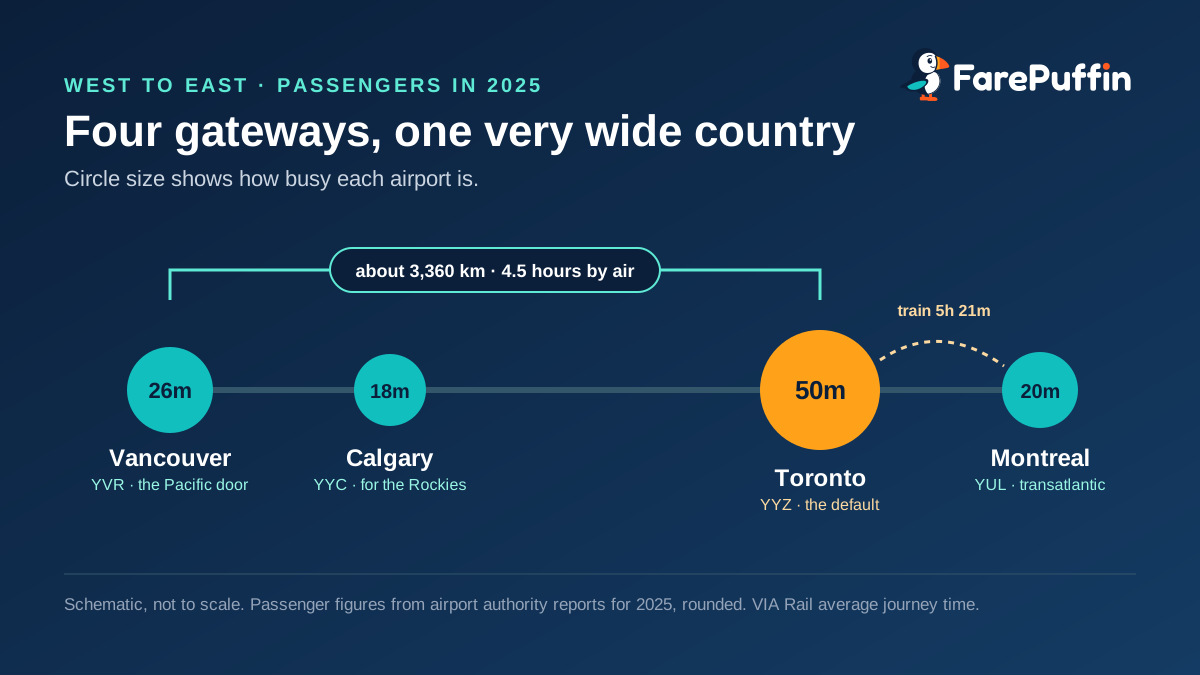
Toronto and Vancouver are about 3,360 kilometres apart, a flight of four and a half hours. So the first decision on any trip to Canada is which side of the country you are visiting, because a cheap fare into the wrong one leaves you with a second long flight to buy.
Four airports carry most of the traffic. In 2025 Toronto Pearson handled about 50 million passengers, Vancouver 26 million, Montreal 20 million and Calgary 18 million. Each does a different job.
Toronto Pearson (YYZ): the default
The largest airport in the country and a hub for Air Canada, WestJet and Porter. It is the natural gateway for Ontario, Niagara Falls and connections onward to almost anywhere in Canada.
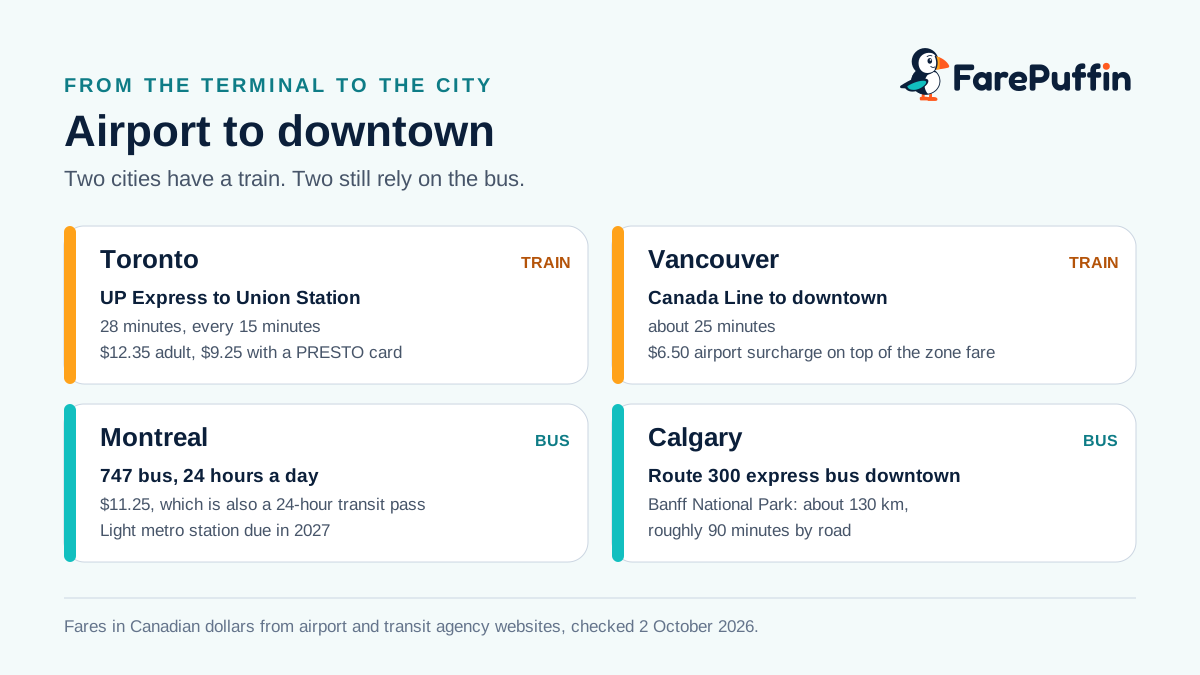
Into the city, take the UP Express train. It runs every 15 minutes, reaches Union Station in 28 minutes and costs $12.35 for an adult, or $9.25 with a PRESTO card.
Short-haul travellers have a second option. Porter and Air Canada Express fly propeller aircraft into Billy Bishop airport on the Toronto Islands, a walk through a tunnel from the downtown waterfront. More on our Toronto page.
Vancouver (YVR): the Pacific door
Vancouver is the country's main transpacific airport, with flights from Tokyo, Seoul, Hong Kong, Shanghai, Manila, Singapore, Sydney and Auckland among others. If Japan is part of the same trip, see our Japan gateways guide. For British Columbia, Vancouver Island and Whistler, start here.
The Canada Line train takes about 25 minutes to downtown. Trips that begin at the airport carry a $6.50 surcharge on top of the normal zone fare, which surprises people at the ticket machine. See the Vancouver page for the city itself.
 Illustrated travel inspiration for Canada.
Montreal (YUL): the transatlantic one
Montreal has the highest share of international passengers of any Canadian airport, and a long list of European routes. Paris is served by Air Canada, Air France and Air Transat, and London by Air Canada and British Airways. For Quebec, and for anyone starting in Europe, it deserves a look alongside Toronto.
There is no rail link yet. A light metro station at the airport is due in 2027. For now the 747 bus runs 24 hours a day for $11.25, and that fare doubles as a 24-hour transit pass. Its downtown terminus moved in January 2026 because of construction, to a stop on René-Lévesque at Berri. Our Montreal page has more, and Quebec City has its own small airport with Paris flights on Air Transat.
Calgary (YYC): the mountain gateway
WestJet's home base, and the airport for Banff, Lake Louise and the Alberta Rockies. The drive to Banff National Park is about 130 kilometres, around 90 minutes on a clear road. Long-haul routes include London, Amsterdam, Paris, Tokyo and Seoul.
Route 300 is the express bus from the terminal into the downtown core. For the mountains, plan your onward transport separately. Read the Calgary page and our guide to national park gateway cities.
The smaller doors
Do not overlook the Atlantic side. Halifax is not a place most overseas visitors think to search, yet in summer WestJet flies there from Dublin, Edinburgh, London Gatwick, Paris, Amsterdam and other European cities. Travellers starting in Britain can compare departure airports on our UK page. St. John's in Newfoundland has seasonal WestJet flights from Dublin, London Gatwick and Paris.
Ottawa has a year-round Air France flight from Paris. Edmonton has KLM from Amsterdam.
Entry rules in brief
- eTA. Visa-exempt visitors arriving by air need an Electronic Travel Authorization. It costs CAD $7 and lasts up to five years. US citizens do not need one.
- Advance Declaration. You can submit your customs declaration in the ArriveCAN app up to 72 hours before landing at ten major airports. It is optional.
- Carrying on to the United States. The major Canadian airports have US border preclearance, so you clear American immigration before boarding and land in the US as a domestic passenger. Our USA page explains why that matters.
Seeing two cities
Within the east, the train works. VIA Rail links Toronto and Montreal in an average of 5 hours 21 minutes, with about six departures a day. Fly into one and home from the other.
East to west is a flight, whichever way you plan it. Air Canada, WestJet, Flair and Porter all fly Vancouver to Toronto nonstop.
Official sources, links checked 8 October 2026
Check airport access and travel requirements with these official sources for your dates. Confirm any dated timetable or price again before booking.