
Straight answer, checked 17 October 2026: For most trips between the two city centres, take the train. Even on this year's slowed timetable the fastest service from Madrid Puerta de Atocha reaches Barcelona Sants in 3 hours 2 minutes, while cheap flights from Madrid to Barcelona, with Iberia or Air Europa, take 1 hour 15 to 1 hour 25 minutes in the air but around 3 hours 40 minutes once both airports are counted. Fly if you are connecting at Barajas, need to leave after about 20:00, or are staying out by the airport.
That is not a fashionable opinion. It is what the passengers already do. According to data from Spain's competition regulator, the CNMC, reported in July 2026, rail carried 83.1% of the combined plane and train market on this corridor in 2025. What is interesting is the other 17%. Madrid to Barcelona is the corridor where the plane holds on best, and in 2026 it has had some help.
Who runs it this autumn
| Operator | Mode | Madrid end | Barcelona end | How often | Journey |
|---|---|---|---|---|---|
| Iberia (Puente Aéreo) | Air | Barajas T4 | El Prat T1 | up to 14 a day each way | 1h15 to 1h25 |
| Air Europa | Air | Barajas T1 or T2 | El Prat T1 | about 2 a day | about 1h20 |
| Renfe AVE | Rail | Puerta de Atocha | Sants | 14 on one October weekday | from 3h02 |
| Ouigo | Rail | Puerta de Atocha | Sants | 5 to 6 a day | 3h02 to 3h30 |
| Iryo | Rail | Puerta de Atocha | Sants | several a day | about 3h |
The Iryo count is not something we could pin down; schedule sites we checked left it out entirely. Renfe's low-cost Avlo brand no longer runs here: Renfe replaced it with AVE trains on Madrid to Barcelona from 8 September 2025, although some booking guides still list it.
On the air side, Vueling flew its last own Madrid to Barcelona service on 29 March 2025 and now sells seats on Iberia's planes. Singapore Airlines starts calling at both cities on 26 October 2026, but its Madrid to Barcelona leg cannot be booked on its own, whatever some flight search sites suggest.
Door to door, honestly measured
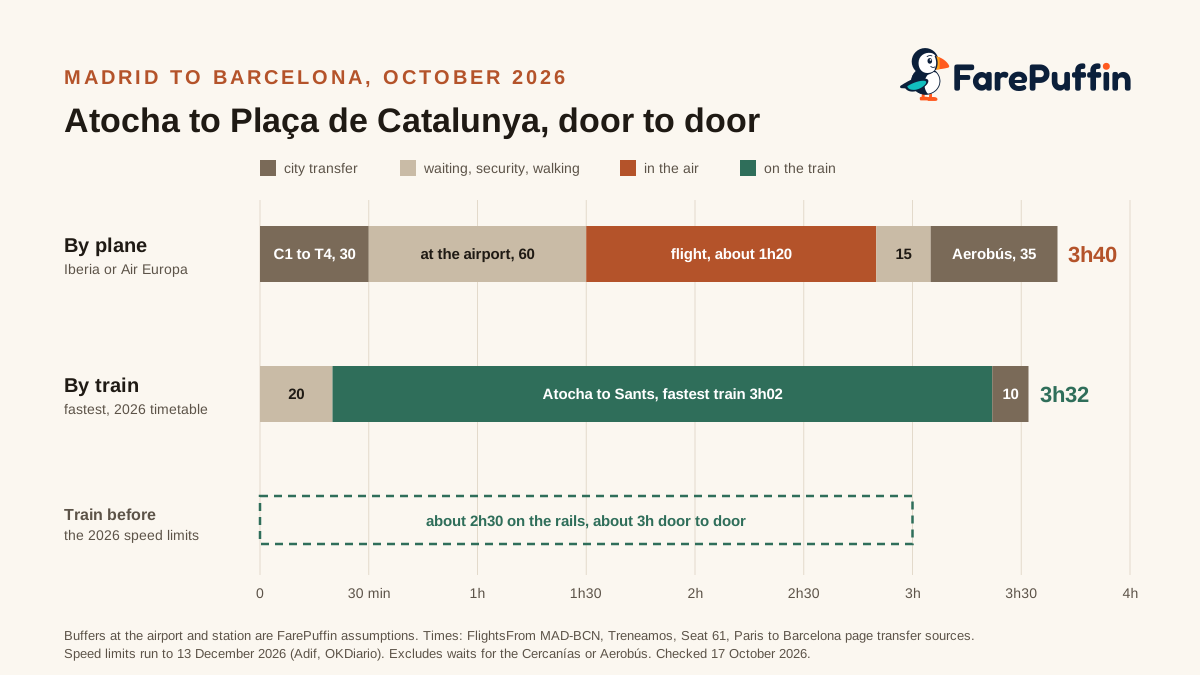
Start at Atocha and finish at Plaça de Catalunya, and the gap is smaller than Renfe's adverts once implied. The airport legs are fixed costs: the Cercanías C1 from Atocha to Terminal 4 takes about half an hour, and in Barcelona the Aerobús A1 needs about 35 minutes to Plaça de Catalunya. The train, meanwhile, drops you at Sants, one metro or Rodalies hop from the old town.
The airport and station buffers in that chart are our own allowances, not airline or Renfe rules. Start from Salamanca or Chamartín and the plane gains a few minutes; start near Atocha or Lavapiés and the train pulls further ahead. Once the speed limits come off, the train wins by about half an hour more.
Flying: worth it for some
Why fly
- The late flight. Iberia's last shuttle leaves at about 21:35. The last train departures on the restricted timetable are around 20:10, and several later trains were cut in February.
- Connections. At Terminal 4 the Puente Aéreo shares a building with Iberia's long-haul network, so an onward trip to Latin America is one check-in.
- A dedicated lane. Iberia keeps a separate Puente Aéreo area with its own desks and kiosks at both airports.
Why not
- Two airport transfers. At El Prat, Terminal 1 has no train; the R2 Nord leaves from Terminal 2, a shuttle bus ride away.
- Security and liquid limits, which the train does not have in the same form.
- Price. Iberia markets the shuttle around flexible tickets with free changes, which suits expense accounts more than bargain hunters. Book early or travel off-peak if the fare matters.
The train: better, but not this year at its best
In its favour
- Centre to centre. Atocha is a walk from the Prado; Sants sits on metro lines 3 and 5.
- Choice of operators. Three companies compete, and Ouigo advertises fares from 9 euros, according to Seat 61. The CNMC figures put the average rail ticket on this corridor at 52.89 euros in 2025, after a 15.2% rise on 2024.
- Usable time. Three hours with a table and a phone signal is a working morning, not dead time.
Against it, for now
- The 2026 slowdown. Adif speed limits on about 250 km of track between Mejorada del Campo and Ricla add around 25 minutes on average, and the operators asked for them to stay in the timetable until 13 December 2026.
- Earlier last trains, as above.
- This week's damage. A fire in an AVE driving cab at Ricla, near Zaragoza, on 12 October 2026 left a 25 km section on reduced speed, with delays of 10 to 15 minutes. Adif expected both tracks back early in the week of 19 October.
 Illustrated travel inspiration for Barcelona, from arrival to exploring the city.
Which hours each one covers
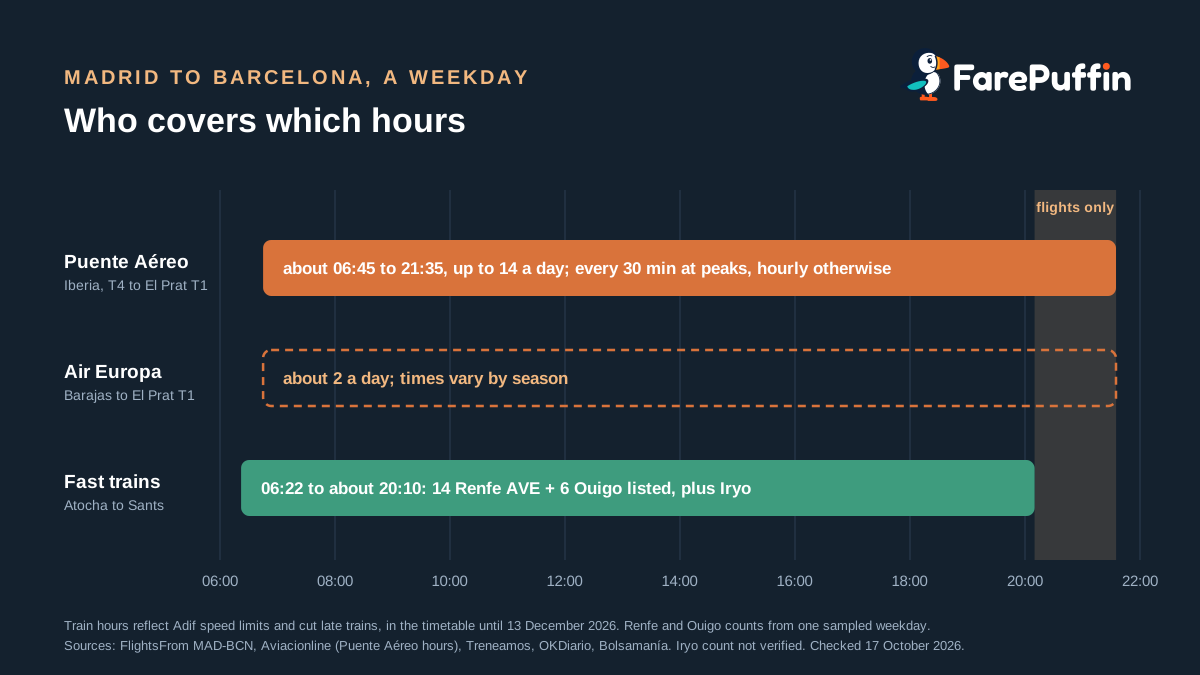
Between about 06:30 and 20:00 the two modes overlap and the train is the default. Outside that, the shuttle is the only fast option. That evening window is the plane's real advantage on this route in 2026, and it explains a good part of why its share is stubborn.
Further along
If Barcelona is the end point, our Barcelona guide covers the city itself, and the airport transfer details for El Prat are laid out on the Paris to Barcelona page. Coming from Portugal, the Lisbon to Barcelona page explains why the overland trip via Madrid rarely pays. Starting in the UK and still choosing between the two cities? Compare London to Madrid, and see our Madrid guide for the capital.
Where the Madrid and Barcelona figures come from
- Flights: FlightsFrom MAD to BCN, Aviacionline on the renewed Puente Aéreo, Ara on Vueling leaving the shuttle, Mainly Miles on Singapore Airlines to Madrid.
- Rail: Seat 61 Barcelona to Madrid, EveryRail Madrid to Barcelona, Treneamos daily timetable, OKDiario on the timetable to 13 December 2026, Metrópoli Abierta on Adif's restrictions, Bolsamanía on cut services, The Objective on the Ricla fire, Railmarket on Avlo leaving Madrid to Barcelona.
- Market data: El Español on CNMC high-speed figures for 2025.
Not verified: Iryo's daily frequency, the undated Iberia frequency and hours (schedule data broadly agrees), Air Europa's Madrid terminal and the Renfe count, which comes from one sampled day. Airport and station buffers are our assumptions. No air fares are quoted.