Does Kyoto have an airport?
Kyoto has no airport of its own. Japan’s official tourism guide identifies Kansai and Itami as its nearest airports. Choose the airport and the onward journey together.
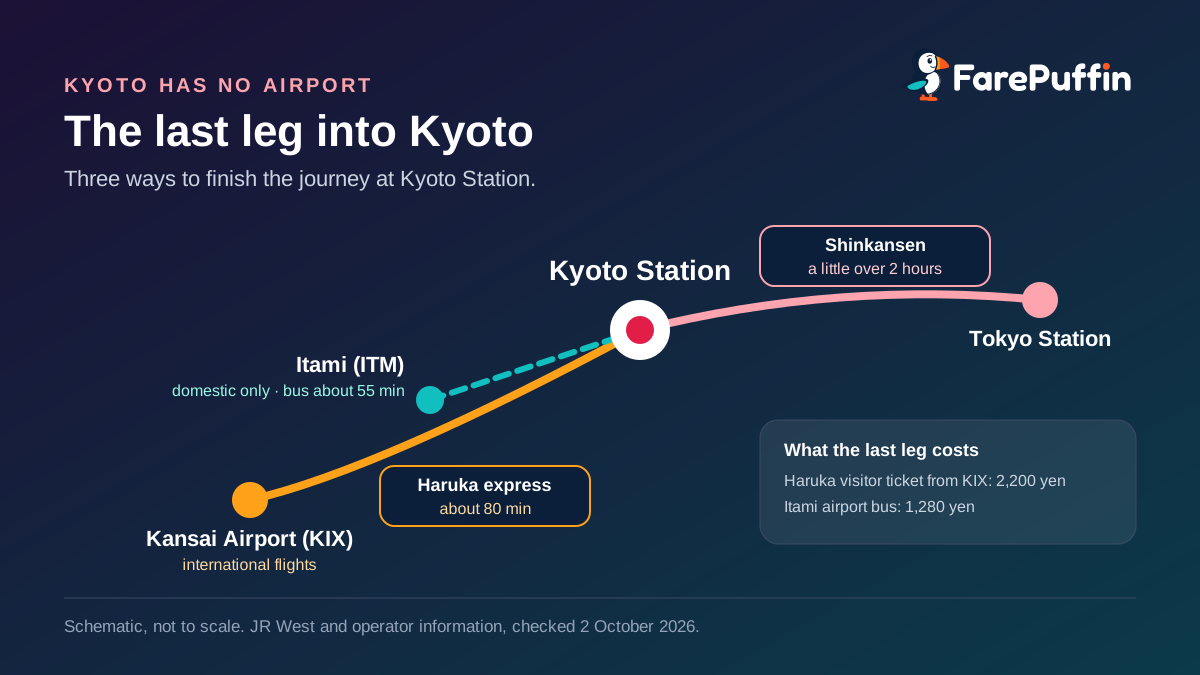
The essentials: Kyoto has no airport. International travellers fly into Kansai International (KIX) and take the Haruka express, about 80 minutes to Kyoto Station, with a 2,200 yen ticket for overseas visitors. Domestic flights use Osaka Itami (ITM), 55 minutes away by airport bus. Prices are as published on 2 October 2026.
Kyoto, a city of roughly 1.4 million people and some of the most visited temples on earth, has no airport. Every visitor who arrives by air lands in a neighbouring prefecture and finishes the trip by rail or road. So "flights to Kyoto" really means two decisions: which Osaka-area airport, and how to cover the final stretch.
Two airports, two different jobs
| Kansai International (KIX) | Osaka Itami (ITM) | |
|---|---|---|
| Flights | International and domestic | Domestic only |
| Where it is | An artificial island in Osaka Bay | Northern Osaka suburbs |
| Best link to Kyoto | Haruka limited express, about 80 minutes | Airport limousine bus, about 55 minutes |
| Rough cost | 2,200 yen with the visitor ticket | 1,280 yen |
| Use it when | You are arriving from abroad | You are connecting from another Japanese city |
If you are flying in from outside Japan, the choice is made for you. KIX is the region's international gateway, and our Osaka page looks at the same airport from the Osaka side.
Kansai Airport to Kyoto Station, step by step
- After customs, follow the signs for JR across the walkway to Kansai Airport Station.
- Collect or buy your Haruka ticket. Overseas visitors can reserve the discounted one-way ticket through JR West's online booking up to a month ahead, then pick it up with a passport.
- Board the Haruka. It runs about every 30 minutes for most of the day, with the first train at around 6:30am.
- Stay on past Tennoji, Osaka and Shin-Osaka. Kyoto Station is about 80 minutes from the airport.
The alternative is the airport limousine bus, which takes 85 to 100 minutes and costs a few hundred yen more than the visitor rail ticket. It earns its place when you have heavy bags and do not fancy lifting them onto a train, since the driver loads them underneath and you sit until Kyoto.
 Illustrated travel inspiration for Kyoto.
Arriving via Tokyo instead
Plenty of itineraries land at Narita or Haneda, often because the fare is better or the trip includes Tokyo anyway. From there you have two ways on.
A domestic flight to Itami, followed by the bus, works well when it is on the same ticket as your long-haul flight and your bags are checked through. The bus leaves from the terminal forecourt about three times an hour and drops you at Kyoto Station.
Otherwise the Shinkansen is hard to argue with: a little over two hours from Tokyo Station to Kyoto Station, with departures every few minutes. If you are spending time in the capital first, take the train and skip the second airport entirely. Our Tokyo page covers Narita and Haneda, and the Los Angeles to Tokyo and San Francisco to Tokyo route pages show how the long-haul leg usually prices. For the choice between Tokyo and Kansai as your arrival airport, see the Japan gateways guide.
The Kyoto year, for people buying plane tickets
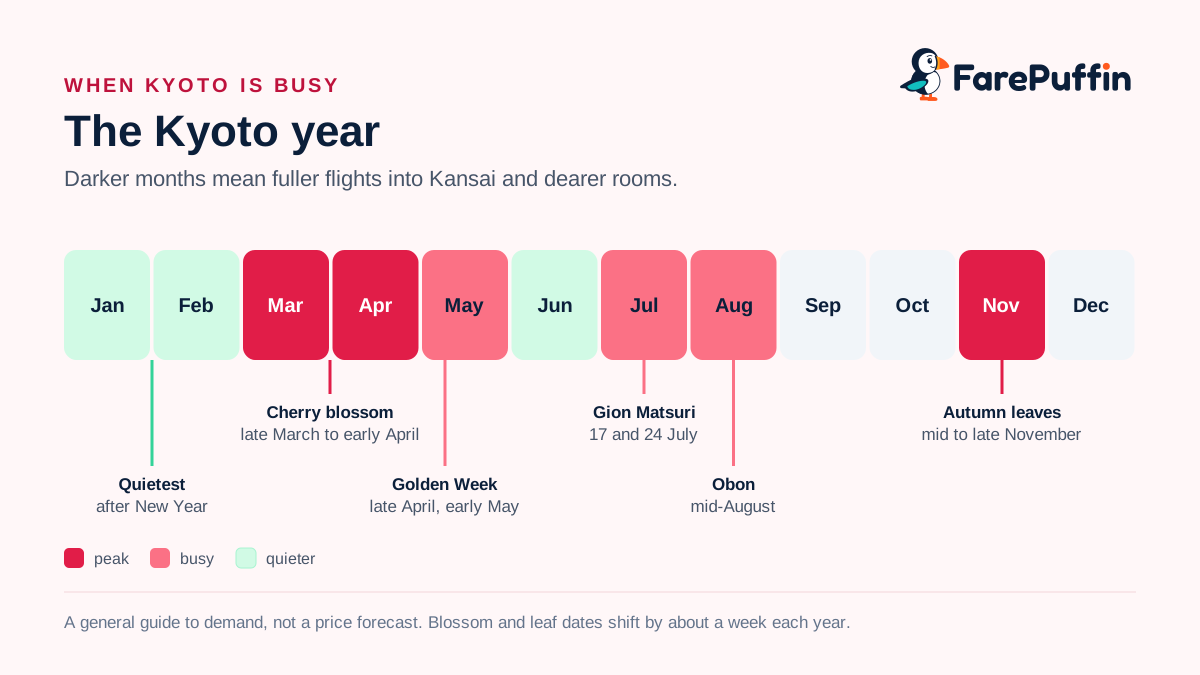
- Late March to early April. Cherry blossom. The most expensive fortnight for both flights into Kansai and rooms in Kyoto. Book months ahead or shift a week either side.
- Late April to early May. Golden Week. Japanese domestic travel peaks, trains sell out and Itami flights are costly.
- June. Rainy season. Quiet temples, green moss gardens, softer prices.
- July. Gion Matsuri, with the great float processions on the 17th and 24th. Hot, humid and crowded in the days before each one.
- Mid-August. Obon, another domestic rush. On the 16th, bonfires are lit on the hills around the city for Gozan no Okuribi.
- Mid to late November. Autumn leaves at Tofuku-ji and Eikando. Second only to cherry blossom for prices.
- January and February. Cold, clear and the cheapest time to come, apart from the New Year holiday itself.
One thing regulars do
Send the suitcase ahead. Delivery counters in the Kansai Airport arrivals hall will forward luggage to a Kyoto hotel, usually for the next day. Kyoto's city buses are small and often full, and some stations involve long corridors and stairs. Travelling in with a day bag makes the first afternoon far easier.
Official sources, links checked 8 October 2026
Check airport access and travel requirements with these official sources for your dates. Confirm any dated timetable or price again before booking.