
How to Use the Southwest Low Fare Calendar and Compare Trip Costs

A low fare is a useful starting point. It is not the whole travel budget.
The Southwest Low Fare Calendar helps you spot cheaper travel dates without searching each day separately. Choose your route, compare the month, and open the dates that suit your trip. Then check the actual flights and the costs that apply to you before booking.
My advice is to make a small shortlist first. Keep two or three workable date combinations, compare the available alternatives on FarePuffin, and add the bags, seats and ground transport you need. A bargain that lands too late for the last train may stop looking like a bargain quite quickly.
This guide walks through that process, including a simple cost comparison you can reuse for your own trip.
What the Southwest Low Fare Calendar shows
The calendar is a way to compare Southwest fares across dates for a selected route. Southwest describes it as showing the lowest fares currently available on each day, a month at a time. That makes it especially useful when you can move your departure or return by a few days. See Southwest's guidance on finding lower fares.
Treat each low price as a date worth investigating. Once you open the flight results, you still need to check the departure time, stops, fare conditions and price for your party.
It also helps to keep the scope clear: this is Southwest's calendar. It does not tell you which airline offers the best overall deal for the same trip. That needs a separate comparison.
How to use the Southwest Low Fare Calendar
1. Start with your route and a realistic travel window
Open the official Southwest Low Fare Calendar. Enter your departure and arrival airports, choose the trip type and relevant month or months, and set the traveler details requested by the form.
Before you search, decide how flexible you actually are. If you must be home by Sunday evening, a cheap Monday return is not useful. If you can leave Wednesday instead of Friday, include that possibility from the beginning.
Use the airport codes to avoid confusion. Two airports serving the same city can mean very different transfers, parking costs and journey times.
2. Compare departure and return dates together
Look for low-priced days that fit your schedule, then consider the return leg. The cheapest departure does not necessarily make the cheapest round trip.
Here is a made-up example: leaving Wednesday might reduce your ticket cost by $40, but require an extra hotel night costing $120. Unless you wanted the longer stay anyway, that change adds $80 to the trip.
This is why I would compare complete date pairs rather than chase a single cheap square on the calendar. Our guide to saving with flexible dates explains the same trade-off in more detail.
3. Open the actual flights for your shortlist
Choose a promising date combination and review the available flights. Check:
- Departure and arrival times, including any arrival on the following day.
- Whether the itinerary is nonstop or has a connection.
- Total journey time and the length of each layover.
- The fare you are selecting and its current conditions.
- The quoted price for all travelers, in the currency you intend to pay.
A low daily fare may belong to an itinerary you would never choose. A long connection or a very early departure can be a reasonable compromise, but make it a deliberate one.
4. Keep two or three workable options
Write down the airport codes, dates, flight times, fare type and current quoted price for each option. A screenshot can help you compare, but it does not hold the fare or guarantee availability.
For a family or group, run the search for the full party. Do not assume a price you saw for one person is available for every traveler.
Check baggage before calling it a deal
Older Southwest guides often say everyone gets two free checked bags. That is no longer a safe assumption.
As checked on October 3, 2026, Southwest lists the following standard fees for U.S. mainland travel booked and ticketed and/or changed on or after April 9, 2026:
| Fare | First checked bag | Second checked bag |
|---|---|---|
| Basic | $45 each way | $55 each way |
| Choice | $45 each way | $55 each way |
| Choice Preferred | $45 each way | $55 each way |
| Choice Extra | Included | Included |
Eligible status, card and military benefits can change the allowance. Weight and size limits apply, and other journeys can have different rules. Check the allowance attached to your reservation using Southwest's official optional travel charges.
For any airline, use the number of bags you expect to take in both directions. Apply any benefit only after confirming that it covers the traveler and booking you are comparing.
Compare the shortlisted dates on FarePuffin
Once you have workable Southwest dates, use FarePuffin's flight search to see what other available itineraries offer for the same journey.
- Enter the same departure and destination airports, dates and traveler count.
- Compare the returned fares, flight times and stops. Use the available filters to narrow the options to journeys you would actually take.
- Open a promising result and review the flight details and available booking options.
- Check the displayed baggage information. If an allowance or fee is unclear, verify it with the selected provider.
- Follow the booking option to the airline or travel provider and confirm the final price and terms before paying.
FarePuffin is a comparison service. You complete the reservation with the selected provider, as explained on our About Us page. The fare displayed during search should not be assumed to include every optional extra.
Keep your Southwest quote alongside those results. Availability depends on the search and data partners, so do not assume every Southwest flight will appear on FarePuffin. If an itinerary is absent, compare it using the quote from Southwest directly.
For nearby airports, run a separate search with the alternative airport codes. Keep the comparison fair by checking both the flight and the journey to your actual destination.
A simple example of the real trip cost
Imagine you are comparing two one-way flights for one traveler. Option A has the cheaper ticket, but you need a checked bag, want a paid seat option and face a more expensive airport transfer.
These are illustrative budgets, not live fares or quotes from specific airlines.
| Cost | Option A | Option B |
|---|---|---|
| Ticket price, including mandatory taxes and fees | $80 | $110 |
| One checked bag | $45 | Included |
| Chosen seat option | $20 | No extra payment |
| Airport transfer | $35 | $15 |
| Total for this comparison | $180 | $125 |
Option B costs $30 more at the ticket stage and $55 less after these expenses. If you travel with only the included cabin baggage and accept the included seating arrangement, your calculation will be different.
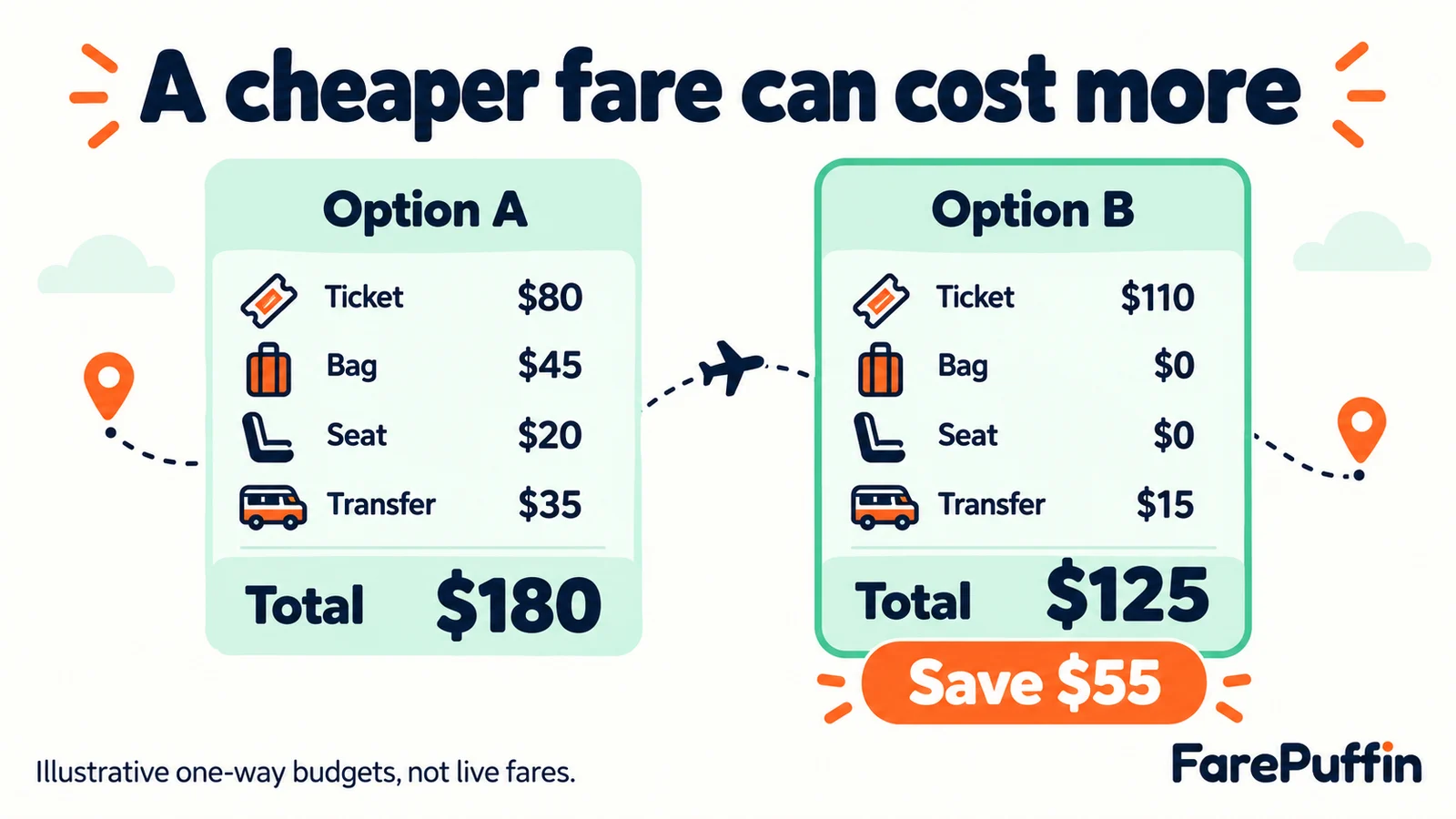 Example budgets only. Add the costs that apply to your own journey.
Use this calculation for each shortlisted option:
Trip cost to compare = ticket total + needed bags + chosen extras + ground transport + extra accommodation caused by the schedule.
Start with the provider's ticket total, so you do not add included taxes twice. For a round trip, include both directions. For a group, distinguish costs charged per person from shared costs such as a taxi.
When a nearby airport or connection is worth considering
A cheaper airport can help, especially if you have someone collecting you or an affordable public transport connection. It can also add enough travel time and expense to erase the savings.
Before choosing it, check the transfer at your actual arrival time. A train that runs during the day does not solve a late-night arrival. Add parking or travel to your departure airport too.
Connections deserve a similar check. Compare the savings with the extra journey time and whether the itinerary is sold as a single ticket. Separate tickets require closer attention to connection risk and baggage collection. Our guide to direct and connecting flights covers the practical trade-offs.
The cheapest option can still be the right one. It just needs to work beyond the search results page.
Common questions about the Southwest Low Fare Calendar
Is there a cheapest day to fly Southwest?
There is no day I would promise will always be cheapest. Compare the calendar for your route and travel window. A midweek flight is worth checking, but demand, holidays and availability can change the result.
Does a low calendar fare guarantee a nonstop flight?
Do not assume it does. Open the results for the date and check the itinerary's stops and total duration before comparing prices.
Why might the price change after I select a date?
The calendar is a starting point. Your selected itinerary, fare or party size may differ from the low-price option you first saw, and availability can change while you search. Check the final quote for your exact journey.
Should I book with Southwest or a provider shown on FarePuffin?
Compare the final price and the terms of each available booking option. Also consider who will handle changes or problems with the reservation. If prices are similar, direct booking may be worth choosing for a simpler point of contact.
Can FarePuffin guarantee the lowest total price?
No comparison result can settle every personal trip expense. Use the available results to build a shortlist, then confirm the booking price, baggage, extras and ground transport yourself.
Choose the cheapest trip that works for you
Use Southwest's calendar to find promising dates. Then compare actual itineraries and add the costs your trip will involve.
You do not need to search endlessly. Two or three realistic date combinations, a clear baggage plan and a quick transfer check will give you a much better basis for deciding.
Ready to compare your shortlist? Search available flights on FarePuffin and keep the Southwest quote beside you until you have checked the final totals.
FarePuffin may earn a commission from qualifying referrals. Read our affiliate disclosure.
Related routes and guides
Use this advice on a real route
Use the guide as a decision filter: compare the base fare, bags, seat choice, airport access, and travel time before calling a ticket cheap.
Route guide
Manchester to Nantes
Use this route page to compare airport fit, baggage costs, timing, and the prefilled search for MAN to NTE.
Route guide
Berlin to Nice
Use this route page to compare airport fit, baggage costs, timing, and the prefilled search for BER to NCE.
Search shortcut
Browse route guides with prefilled searches
Move from advice to a route page where airport codes, fare context, and the search form are already aligned.